
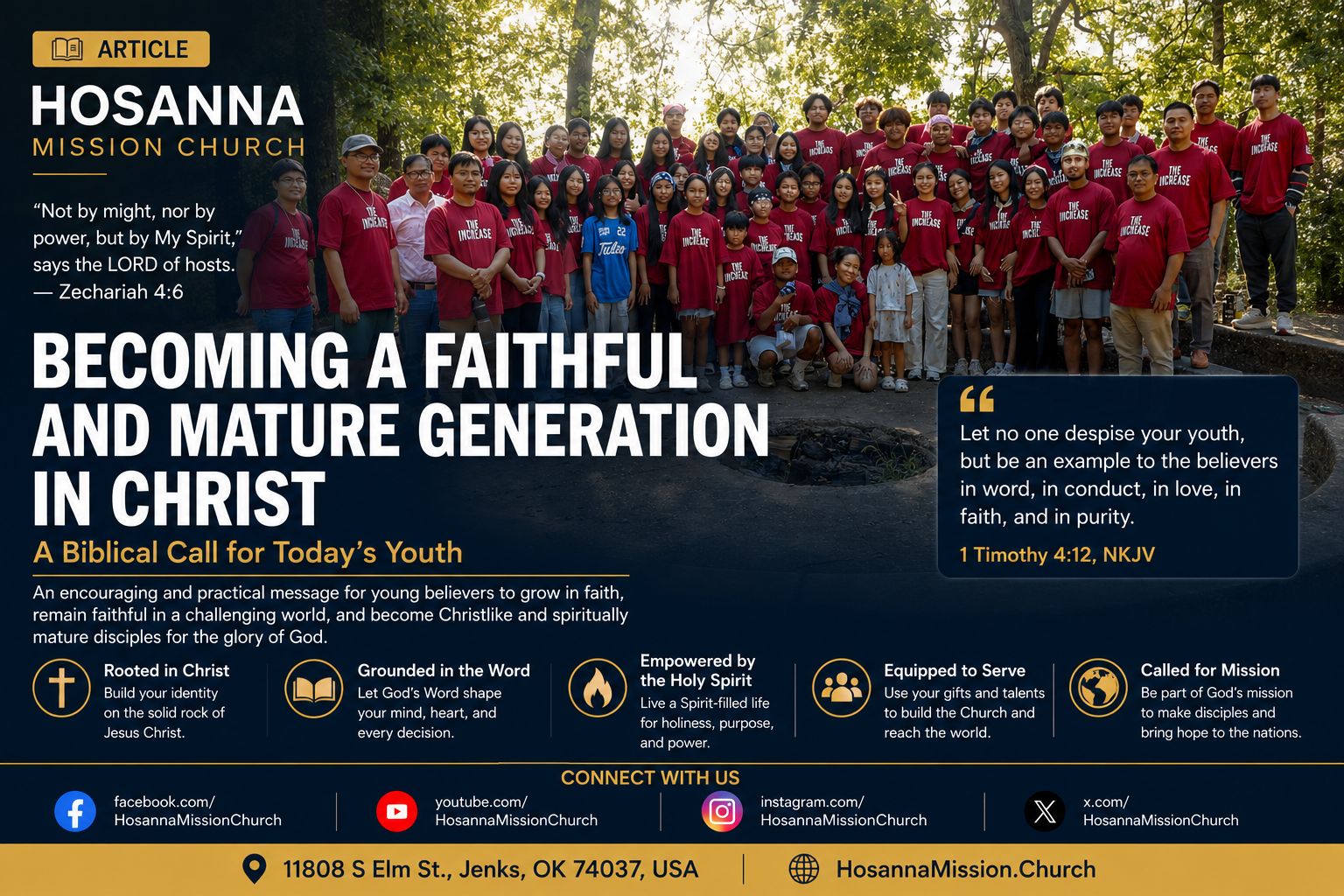
“Let no one despise your youth, but be an example to the believers in word, in conduct, in love, in faith, and in purity.” — 1 Timothy 4:12, NKJV
The Church must never think of young people merely as its future. They are already part of the Church’s life, witness, and mission today.
At Hosanna Mission Church, our desire is not simply to gather young people for activities. We want to see a generation formed by the Word of God, grounded in Jesus Christ, filled with the Holy Spirit, and prepared to serve faithfully in the Church and in the world.
Our young people live in a demanding and confusing time. They face constant pressure from social media, entertainment, relationships, academic expectations, cultural change, and the desire to be accepted. These influences do more than occupy their time; they shape how they understand truth, identity, success, morality, and purpose.
For this reason, Christian youth ministry must offer more than inspiration. It must provide biblical formation. Young believers need a faith that is thoughtful, disciplined, Christ-centered, and strong enough to endure pressure.
God Calls Young People to Spiritual Maturity
Spiritual maturity does not happen automatically. A person may grow older without growing wiser, and may attend church for many years without developing a deep and obedient faith.
The writer of Hebrews warned believers who had remained spiritually immature:
“But solid food belongs to those who are of full age, that is, those who by reason of use have their senses exercised to discern both good and evil.”
— Hebrews 5:14, NKJV
A mature Christian is not simply someone who knows many Bible verses. Maturity is seen when biblical truth shapes a person’s decisions, relationships, speech, habits, and priorities.
Spiritual maturity includes learning to:
- distinguish truth from error;
- receive correction without resentment;
- remain faithful when feelings change;
- resist temptation;
- make wise decisions;
- serve without seeking recognition;
- forgive others;
- accept responsibility; and
- obey God even when obedience is costly.
The goal of Christian discipleship is not merely informed believers, but transformed believers.
Build Your Identity in Christ
One of the greatest questions facing young people is, “Who am I?”
The world often answers this question through appearance, popularity, achievement, relationships, emotions, ethnicity, social status, or online attention. But all these things can change. An identity built upon them will always remain uncertain.
The Christian’s identity is rooted in Jesus Christ.
Those who repent and believe in Him are forgiven, reconciled to God, adopted into His family, and given new life through the Holy Spirit. Their value is not determined by public approval but by the grace of God.
Paul wrote:
“For you died, and your life is hidden with Christ in God.”
— Colossians 3:3, NKJV
Young believers must learn to say:
- I am not defined by my mistakes.
- I am not controlled by the opinions of others.
- I do not need popularity to have value.
- My life belongs to Jesus Christ.
When identity is secure in Christ, a young person can stand for truth without becoming proud, love others without compromising conviction, and face rejection without losing hope.
Character Matters More Than Talent
The world often rewards visibility, confidence, appearance, and ability. God looks more deeply. He examines the heart.
Talent can open doors, but character determines what a person will do once those doors are opened. A gifted person may attract attention, but only a faithful person can carry responsibility well.
Paul instructed Timothy to become an example in speech, conduct, love, faith, and purity. He did not tell Timothy to prove himself through popularity or performance. His credibility was to come from the integrity of his life.
Christlike character includes:
- humility instead of pride;
- purity instead of compromise;
- truthfulness instead of manipulation;
- patience instead of uncontrolled anger;
- compassion instead of selfishness;
- forgiveness instead of bitterness; and
- service instead of entitlement.
The Church does not simply need talented musicians, speakers, media creators, or leaders. It needs trustworthy disciples whose gifts are governed by holiness and love.
Before asking, “How can I become successful?” a Christian should first ask, “How can I become faithful?”
Faithfulness Is Formed in Daily Life
Many people imagine that faithfulness is demonstrated only through great acts of courage. In reality, it is usually developed through small acts of obedience repeated over time.
Faithfulness means praying when no one is watching. It means reading Scripture even when one does not feel spiritually excited. It means honoring parents, keeping promises, arriving on time, completing responsibilities, speaking truthfully, and refusing temptation.
Jesus taught that those who are faithful in little can be trusted with more.
David learned responsibility while caring for sheep before he stood before Goliath. Joseph practiced integrity in slavery and imprisonment before he governed Egypt. Daniel developed disciplined faithfulness long before he became influential in Babylon.
Young people should not despise seasons of preparation. God often forms public servants through private obedience.
Learn to Think Biblically
Young Christians are surrounded by messages that compete for their attention and loyalty. Social media, entertainment, friends, influencers, and public movements all present ideas about identity, sexuality, relationships, success, justice, and happiness.
Not every popular idea is true. Not every emotional claim is wise. Not every spiritual message is biblical.
Paul wrote:
“And do not be conformed to this world, but be transformed by the renewing of your mind.”
— Romans 12:2, NKJV
- A renewed mind does not accept everything uncritically. It learns to test ideas through Scripture.
- Young believers should regularly ask:
- Does this agree with the Word of God?
- Does this honor Jesus Christ?
- Will this strengthen or weaken my faith?
- Does it lead toward holiness, love, wisdom, and self-control?
- What kind of person will I become if I continue following this influence?
- Biblical discernment does not mean being fearful of the world. It means engaging the world without allowing it to control the mind and heart.
Spiritual Strength Requires Discipline
No one becomes spiritually mature by accident.
Prayer, Bible reading, worship, fasting, fellowship, and service are not ways of earning salvation. Salvation is received by grace through faith in Jesus Christ. Yet these practices help believers grow in the grace they have received.
A healthy Christian life should include:
Daily prayer. Speak honestly with God, confess sin, give thanks, and seek His guidance.
Regular Scripture reading. Do not read only to complete a task. Read to understand God’s character, will, and truth.
Faithful worship. Be present in the life of the local church, not only when it is convenient.
Christian fellowship. Build relationships with believers who strengthen your faith and correct you in love.
Practical service. Use your time and abilities to help others and strengthen the Church.
Personal accountability. Be honest about your struggles and willing to receive guidance from mature leaders.
Discipline is not the enemy of spiritual life. Proper discipline creates room for steady growth.
Pursue Holiness Without Hiding Your Struggles
Holiness is not an outdated religious idea. It is a life set apart for God.
God’s call to holiness reaches every part of life: thoughts, speech, relationships, sexuality, entertainment, ambitions, finances, and use of time.
This does not mean that mature Christians never struggle or fail. It means they refuse to make peace with sin.
When believers fall, they should not hide from God or pretend that nothing happened. They should confess, repent, seek help, and return to faithful obedience.
“If we confess our sins, He is faithful and just to forgive us our sins and to cleanse us from all unrighteousness.”
— 1 John 1:9, NKJV
Grace does not excuse sin. Grace forgives, restores, and empowers us to change.
No young person should believe that failure must define the rest of life. In Christ, there is forgiveness and a new beginning. Restoration may require honesty, accountability, patience, and difficult changes, but God is able to rebuild a surrendered life.
Depend Upon the Holy Spirit
Christian maturity cannot be produced by human effort alone.
Hosanna Mission Church is guided by the words:
“Not by might, nor by power, but by My Spirit,” says the LORD of hosts.
— Zechariah 4:6, NKJV
Young believers need more than motivation. They need the transforming and empowering work of the Holy Spirit.
The Holy Spirit convicts us of sin, illuminates Scripture, produces spiritual fruit, gives gifts for ministry, strengthens us in temptation, and empowers us to witness for Jesus Christ.
Jesus said:
“But you shall receive power when the Holy Spirit has come upon you; and you shall be witnesses to Me.”
— Acts 1:8, NKJV
To be Spirit-filled is not merely to experience a powerful moment in worship. It is to live under the Spirit’s direction with increasing love, holiness, courage, humility, and obedience.
Seek the fullness of the Holy Spirit. Ask Him to purify your motives, guide your decisions, strengthen your character, and use your life for the glory of Christ.
Take Your Place in the Church
Young people should not remain spectators in the Church.
They need opportunities to pray, worship, serve, learn, lead, evangelize, and participate in missions. They can serve through music, media, technology, children’s ministry, hospitality, administration, teaching, prayer, outreach, and many other areas.
At the same time, ministry responsibility must be joined with spiritual formation. A platform cannot replace character. Public involvement cannot replace private devotion. Ability cannot replace accountability.
The Church must not only give young people something to do. It must help them become faithful disciples while they serve.
Young believers also need relationships with older Christians who can teach, encourage, correct, and pray for them. The Church is an intergenerational family. Mature believers need the energy and creativity of the young, while young believers need the wisdom and stability of those who have walked with Christ for many years.
Choose Relationships Wisely
The people closest to us influence the direction of our lives.
“He who walks with wise men will be wise, but the companion of fools will be destroyed.”
— Proverbs 13:20, NKJV
Christians are called to love everyone, including those who do not share their faith. But loving everyone does not mean allowing everyone to shape our values and decisions.
Choose close friends who encourage prayer, respect Scripture, promote purity, speak truth, and help you become more faithful to Christ.
A good friend does not simply agree with everything you do. A good friend cares enough to warn you when you are moving in the wrong direction.
Be compassionate toward all people, but choose your strongest influences carefully.
Live With a Sense of Mission
Spiritual maturity is not only about personal improvement. Mature believers participate in God’s mission.
Jesus commands His followers to make disciples of all nations. Young Christians share in this calling now.
Your mission field may be your home, school, workplace, university, neighborhood, social-media platform, or friendship group. God can use your education, profession, creativity, language, technology, and testimony for the Gospel.
Do not ask only, “What career will make me successful?” Ask also, “How can my life and work serve the Kingdom of God?”
God can raise pastors, missionaries, teachers, professionals, worship leaders, intercessors, entrepreneurs, media workers, and servant-leaders from this generation.
Whatever your calling may be, offer it fully to Christ.
A Pastoral Charge to the Youth
You are loved by God, valued by this church, and called to a meaningful life in Christ.
Do not settle for a shallow faith.
Do not confuse church attendance with discipleship. Do not allow social media to shape you more deeply than Scripture. Do not waste your gifts through carelessness. Do not build your identity upon the approval of others. Do not allow past failure to silence your future obedience.
- Know Jesus Christ personally.
- Study the Word of God carefully.
- Pray consistently.
- Walk in purity.
- Honor your parents and spiritual leaders.
- Receive correction humbly.
- Serve the Church faithfully.
- Choose your relationships wisely.
- Share the Gospel courageously.
- Seek the fullness of the Holy Spirit.
- Become an example in speech, conduct, love, faith, and purity.
Our prayer is not simply that HMC youth will become successful people. We pray that they will become faithful Christians—men and women of truth, wisdom, compassion, courage, and spiritual maturity.
May this generation be known not merely for its talent, but for its character; not merely for its activity, but for its faithfulness; and not for dependence upon human strength, but for complete reliance upon the Holy Spirit.
May their lives declare:
“Not by might, nor by power, but by My Spirit,” says the LORD of hosts.
In the name of Jesus Christ,
Amen.
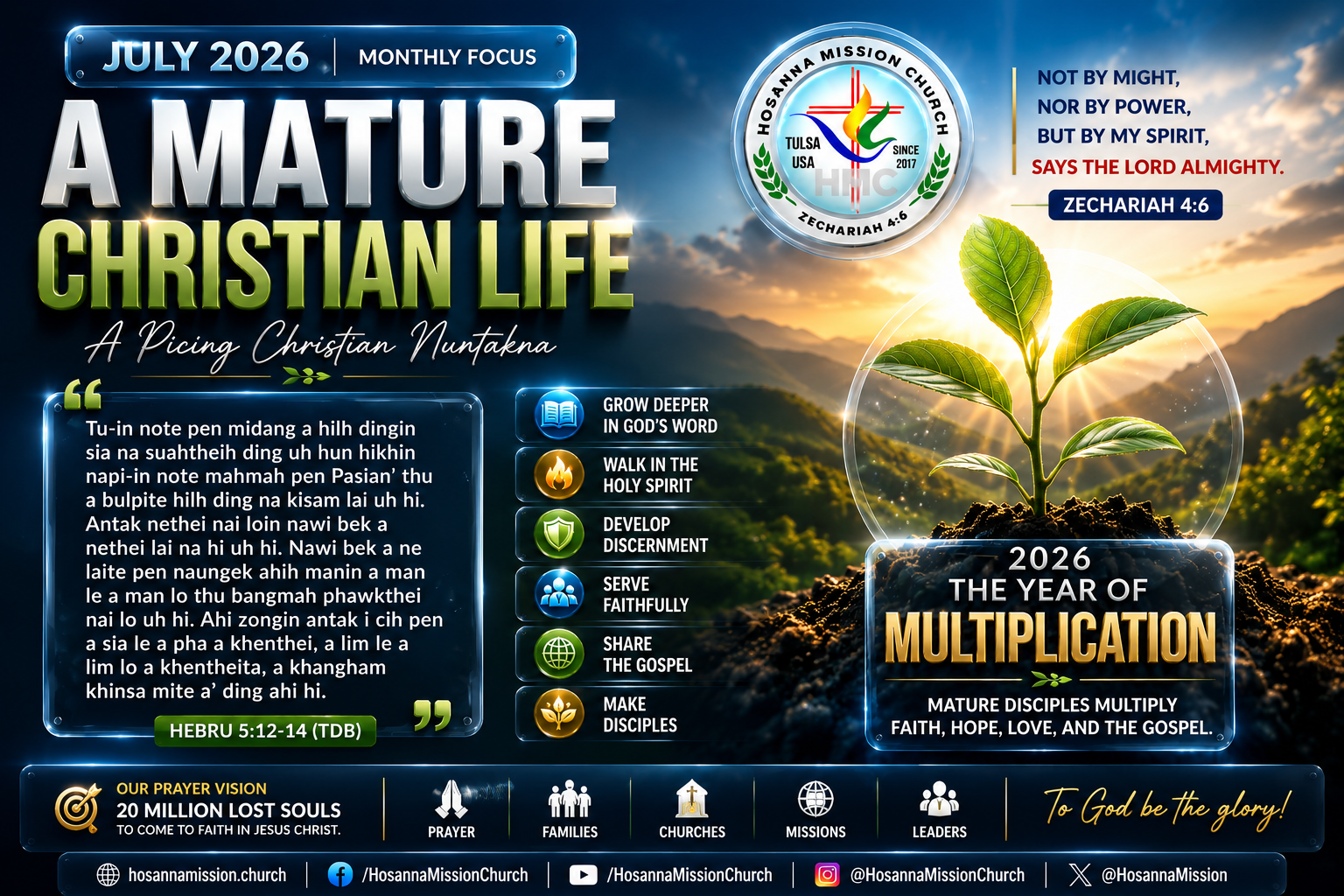
A Mature Christian Life
Growing in Christ During the Year of Multiplication Hosanna Mission Church – July 2026 Monthly Focus “Tu-in note pen midang a hilh dingin sia na...
Na Buk Mun Khan In (Isaiah 54:2)
“Na buk mun khan inla, na teenna puanbukte kizalsak in;cil bawl kei in, na khaute sausak inla, na khetphimte kipsak in.Israel mite in Egypt gam ah kum 400 sung...
Abraham Pasian Isaac Pasian, Jacob Pasian –2
Isaak Pasian cih leh Pasian in Abraham kiang ah na tapa isaak tawh kei nongbia ding hi ci in na ze-et a tua lai ah...

A Zo Zo Hi
Ling Lukhu: Ling pen i khuk lai tak na mah mah hi. Ahi zong tua ling te tawh i buh lo ci dia i vam lo...